Housemartin’s arrest and death in custody
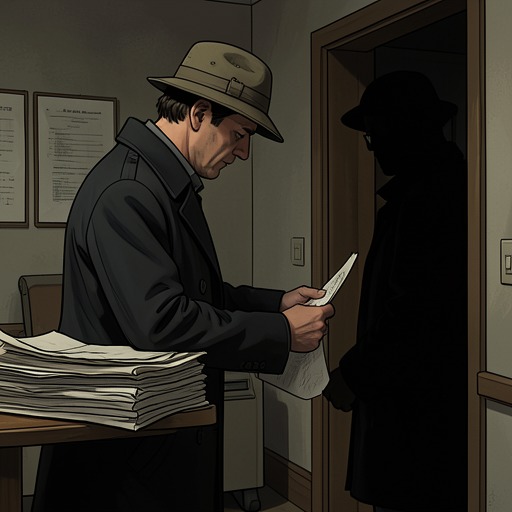
The IPCRESS FileHousemartin’s arrest and death in custody turn a police stop into an urgent intelligence operation, then into a failure that the Unnamed narrator encounters firsthand. A constable’s recognition of a man impersonating a senior police officer leads to the discovery of a high-priority file; the narrator responds with explicit precautions, only to arrive at Shoreditch Police Station and find Housemartin dead. The sequence makes the gap between official control and what actually happened the event’s central fact, while leaving the cause of death unstated.
Recognition and the green card
The arrest begins when a constable asks Housemartin for his licence and related documents. The man’s unusual presentation is soon more important than the traffic matter: he is dressed as a Metropolitan Police Chief Inspector. The constable has worked for a year at the Criminal Records Office and recognizes Housemartin’s face. That experience also shapes his judgment of the record. He expects to find a white card, but Housemartin has no such record; instead, there is a green card for a suspected person without a criminal record.
The green card is endorsed to the narrator’s department and marked with a star indicating top priority. The constable therefore contacts Keightley rather than treating the matter as an ordinary arrest. He asks whether Shoreditch should be told about the card and whether the department wants Housemartin held. The procedure makes the arrest consequential before the narrator knows the full circumstances: a man caught in a police uniform is also already registered as a priority concern, though not as someone with a criminal conviction.
Orders for custody
The narrator’s response is immediate and unusually specific. He tells Keightley to have Housemartin held, stripped, and watched carefully for cyanide pills. He also directs that the prisoner be kept under lock and key from the moment the call ends, with constant observation, and makes the local chief personally responsible for Housemartin’s safety. These instructions present the arrest as a security problem as well as a policing matter: the narrator anticipates that Housemartin may pose a danger to himself or that something about his custody requires exceptional care.
The narrator also singles out the constable who made the arrest, asking that he remain available and remarking that he deserves promotion for bringing in a man disguised as an inspector. He says he is leaving at once and expects to reach the station before 7:30. The attention to both the prisoner and the arresting officer gives the scene two immediate stakes: preserving Housemartin’s life and establishing exactly how he came to be in custody.
Discovery at Shoreditch
By the time the narrator and Murray arrive, the station presents itself as secure. Three policemen stand at the entrance, and the sergeant tells them that everything is under control. He mentions two other people who are parking their car. The narrator’s response is a sudden physical alarm; when they reach Housemartin, he is naked, lying horizontally, and dead. The time is 7:33, only minutes beyond the narrator’s stated deadline for arrival.
The body is described as that of a strong, good-looking man of about thirty-five. The narrator turns it over and notes that Housemartin looks older at close range than he had on their previous encounter. He concludes that Housemartin can be removed from their files, while adding that Jay’s people are removing him from theirs at that very moment. The juxtaposition links the death to competing intelligence interests without identifying who caused it or how. Housemartin’s clothing has been removed, as the narrator ordered, but the central safeguard—keeping him alive under observation—has plainly failed. The passage gives no medical explanation for the death and does not establish whether the cyanide concern was relevant.
The constable’s account and the unresolved death
The narrator immediately asks for the constable who brought Housemartin in and questions him about what happened. PC Viney arrives with a partly written report and a short pencil. His relaxed, shrewd manner is presented as consistent with someone who had recognized a man wearing an inspector’s uniform, rather than as proof that every detail of the arrest is known. The sergeant, meanwhile, is preoccupied with his long service and pension, a contrast to the narrator’s demand for an exact account of events.
Viney says that Housemartin’s demeanour had made him suspicious from the first, but that he would not have approached closely enough to recognize him if Housemartin had not hit a traffic light. Asked whether the man might have come from one of the nearby houses, Viney thinks he may have been pulling out into traffic. The narrator tells him not to let concerns about what could be proved in court prevent him from offering even a flimsy guess, then asks him to think through the row of houses and how well he knows it. This questioning opens a possible line of inquiry about where Housemartin had come from; the available account does not resolve it. The event closes not with an explanation of the death, but with the narrator turning the failed custody into an investigation of the arrest’s circumstances.